Immortal or Incorruptible? What the Bible Actually Means by Both
At first glance, ‘incorruptible’ and ‘immortal’ seem like two sides of the same coin, but the Bible shows they describe two distinct states.
In 1 Corinthians 15:53, the apostle Paul writes: ‘For this corruptible must put on incorruption, and this mortal must put on immortality.’ Paul is not using repetitive language for emphasis; instead, he is describing two different states.
In fact, there are several descriptors used in the Bible to describe future states for man including celestial and terrestrial, physical and spiritual, and heavenly and earthly.
How are we to understand these different aspects described for us in the Bible? And do we really need to?!
Is it enough to know that Jesus will provide a transformation at the end of this age? Or should we seek to understand why the Apostle Paul went to some lengths in 1 Corinthians 15 to clarify different aspects of ‘glory’ that are part of God’s masterplan?
Understanding spirit, soul and body
A key to exploring this topic is to first understand what man is made up of.
Humans are made up of three parts: spirit, soul, and body (1 Thessalonians 5:23).
Our spirit is our life source, given by God (Gen 2:7, Ecc 12:7, Zech 12:1) and is how we connect to God (John 4:24, 1 Cor 6:17, Rom 8:16). Our soul is our consciousness (mind, will and emotions), the essence of our inner person. Our body is the physical part of our being that can be handled – our flesh and blood. ‘What happens after death’ (linked article) provides more detailed explanations of these parts and the distinct experience of each part if a person dies.
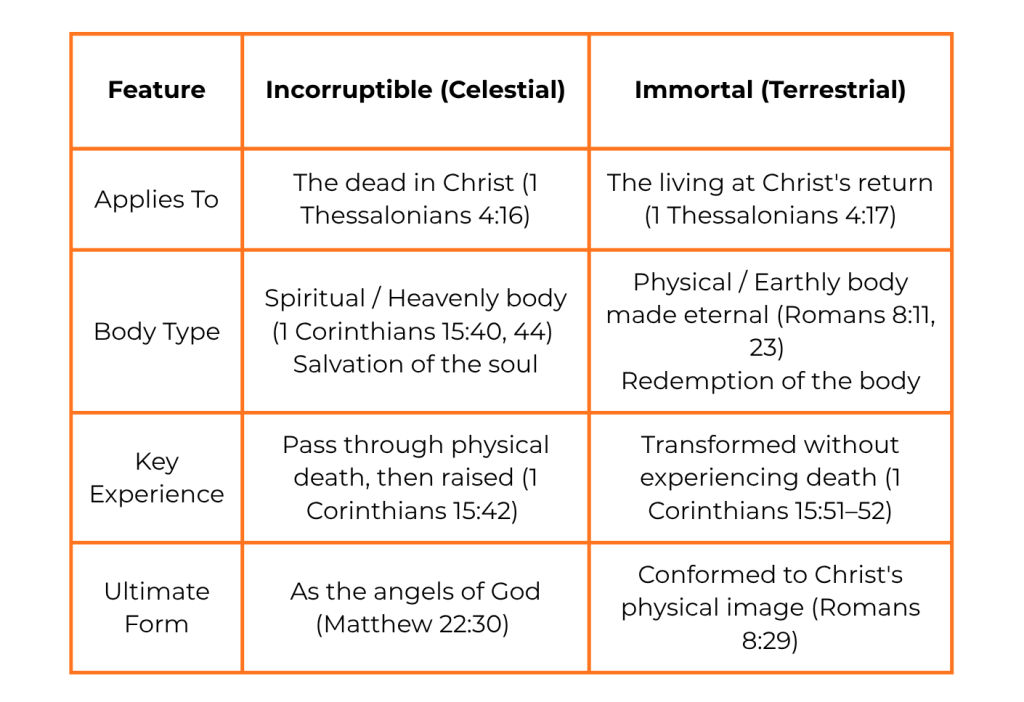
Incorruptible – a spiritual body
The word ‘corrupt’ describes something marred by sin and subject to physical decay in the grave (Psa 16:10, Gen 6:11–12, Rom 1:23). When Adam and Eve sinned, a curse was pronounced upon mankind, resulting in the physical death of the body—dust returning to dust (Gen 3:19, Ecc 12:7, Rom 5:12, 6:23).
When a person dies, their physical body corrupts in the grave and returns to dust (Ecc 12:7, Job 7:9–10), their spirit returns to God (Ecc 12:7) and their soul sleeps in the grave until the resurrection (Job 33:29–30, Luk 16:22–23).
At the resurrection, God gives these believers a new, spiritual celestial body.
- 1 Corinthians 15:42–44: ‘It is sown in corruption; it is raised in incorruption… It is sown a natural body; it is raised a spiritual body.’
- 1 Corinthians 15:52: ‘The dead shall be raised incorruptible…’
- 1 Thessalonians 4:16: ‘The dead in Christ shall rise first.’
The resurrected dead receive ‘soul salvation’ (1 Peter 1:3–4), becoming like the angels in heaven (Matthew 22:30, Luke 24:39). They live and reign with Christ in this newness of life (Romans 6:4, Revelation 20:4–5).
Note that Paul is clear that the resurrected body is not a physical body. The spirit and soul of a person are formed into a new spiritual body. The resurrected dead are ‘raised in incorruption … raised in glory … raised a spiritual body’ (1 Cor 15:42-44). They are incorruptible because they are no longer subject to death or decay in the way that their physical body was.
Immortal – a physical body
The term ‘mortal’ comes from the root for death, meaning subject to dying. Man was initially created immortal (Wisdom of Solomon 2:23–24; see also Genesis 1:27 and Romans 5:12), but through the sin of Adam and Eve, a curse of death was placed on the body. However, Scripture reveals that returning to an immortal state is possible at Christ’s return.
Paul contrasts the incorruptible state with the immortal state. He makes an interesting claim in 1 Corinthians 15:51 – that not everyone will sleep in the grave. Some will remain alive (being mortal) and be changed to immortal without experiencing death. This is an astonishing promise! Many believers are excited about the prospect of a new life in heaven after they die, but how many have contemplated this promise of bypassing death and being immortal – keeping their spirit, soul and body?
The Bible provides examples of individuals who were transformed and taken from earth with terrestrial bodies, without experiencing death. Enoch and Elijah are prominent examples, as both were translated directly into heaven (Genesis 5:24, 2 Kings 2:11). Hebrews 12:23 refers to them as ‘just men made perfect’, showing that these individuals were perfected and taken into heaven with immortal terrestrial bodies. Their translation reflects the possibility of physical bodies being transformed, without death, before the first resurrection.
The immortal glory that Paul is speaking about is explained further in the New Testament, and he provides another key in Romans 8:11 – ‘But if the Spirit of him that raised up Jesus from the dead dwell in you, he that raised up Christ from the dead shall also quicken your mortal bodies by his Spirit that dwelleth in you.’
Having the fullness of Christ and the Holy Ghost physically indwelling a body can change it to an immortal body. Rather than dying and being resurrected, the physical body itself is redeemed, cleansed, and ‘quickened’ by the Holy Ghost. Paul refers to this again in Romans 8:23: ‘…waiting for the adoption, to wit, the redemption of our body.’ Note again he is not referring to the salvation of the soul as he does in other parts of Scripture.
The Scriptures show that Jesus demonstrated both incorruptible (spiritual) and immortal (physical) states following His resurrection. Initially, He appeared in a purely spiritual state, saying to Mary, ‘Touch me not; for I am not yet ascended to my Father’ (John 20:17). Later, He demonstrated a physical immortal body, inviting His disciples to examine Him: ‘Handle me, and see; for a spirit hath not flesh and bones, as ye see me have’ (Luke 24:39).
One thing is certain. When Jesus Christ returns ‘we shall all be changed’. The dead in Christ shall rise first (incorruptible) (1 Thess 4:16), ‘then we which are alive and remain (immortal) shall be caught up together with them in the clouds, to meet the Lord in the air: and so shall we ever be with the Lord’ (1 Thess 4:17).
Questions to Ponder
Understanding the difference between incorruptible and immortal isn’t just about theological debate; it changes how we prepare for the return of Jesus Christ.
- If the Godhead dwelling within us has the power to quicken our mortal bodies, how intentionally are we yielding our bodies to Him day by day?
- Are we living with the active expectation of being among ‘those who are alive and remain’?
- How might your daily walk change if you truly lived believing your physical body was destined for redemption, rather than just preparing for the salvation of your soul after death?
Key Summary